Particle (Basic ㊦ 349)
A particle which indicates a space in/on/across/through/along which someone or something moves.
Equivalent: In; on; across; through; along; over
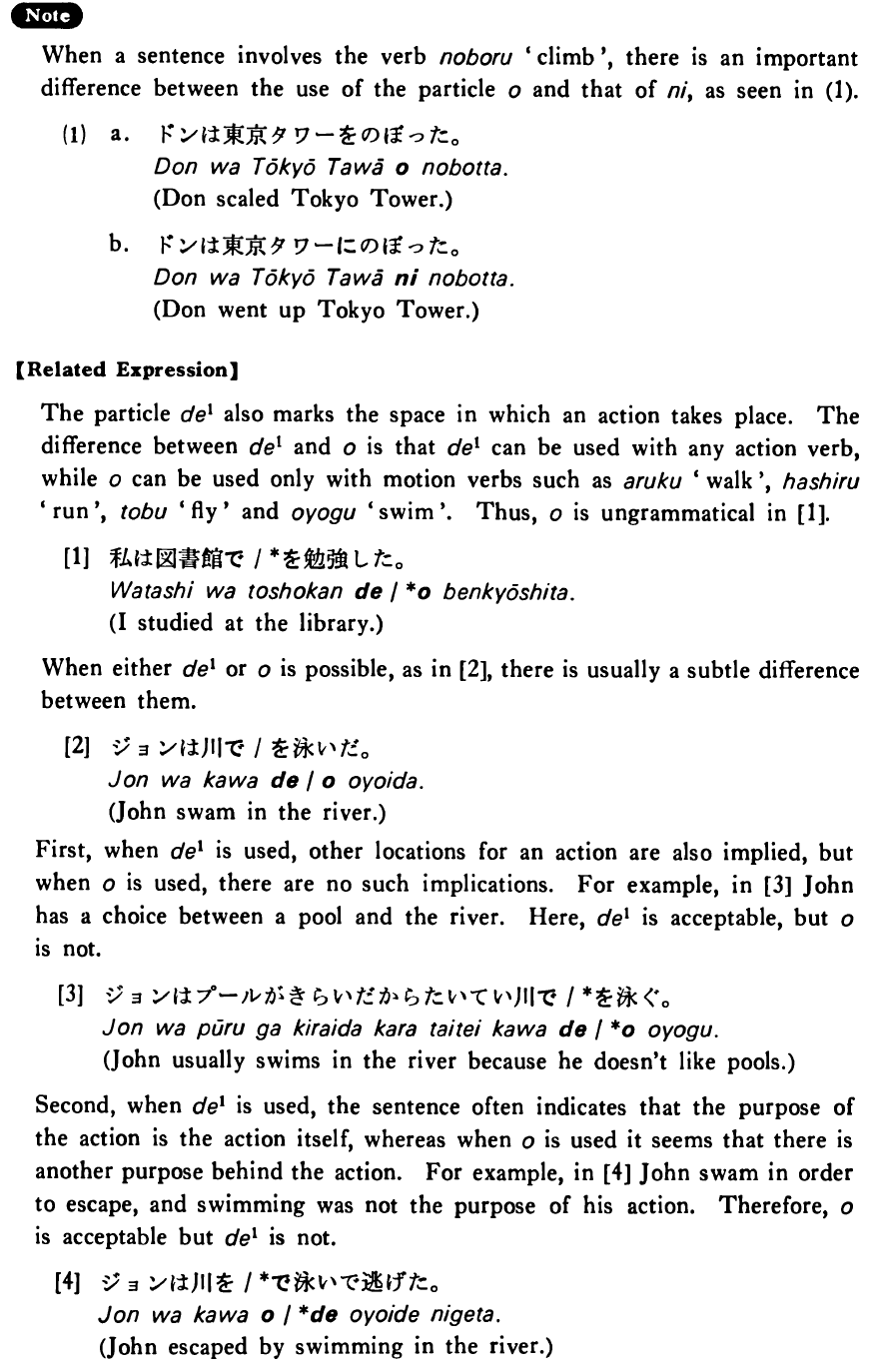
When a sentence involves the verb 登る 'climb', there is an important difference between the use of the particle を and that of に, as seen in (1).
【Related Expression】
The particle で1 also marks the space in wmch an action takes place. The difference between で1 and を is that で1 can be used with any action verb, while を can be used only with motion verbs such as 歩く 'walk', 走る 'run', 飛ぶ 'fly' and 泳ぐ 'swim'. Thus, を is ungrammatical in [1].
[1]
When either で1 or を is possible, as in [2], there is usually a subtle difference between them.
[2]
First, when で1 is used, other locations for an action are also implied, but when を is used, there are no such implications. For example, in [3] John has a choice between a pool and the river. Here, で1 is acceptable, but を is not.
[3]
Second, when で1 is used, the sentence often indicates that the purpose of the action is the action itselt, whereas when を is used it seems that there is another purpose behind the action. For example, in [4] John swam in order to escape, and swimming was not the purpose of his action. Therefore, を is acceptable but で1 is not.
[4]